
construction Contact Service email General Contact public Contact Sales travel_explore Contact Partner
construction email public travel_explore
Filter monitoring

Comprehensive filter monitoring for industrial dust control

In industrial environments, effective dust control is not just a regulatory requirement, it’s a cornerstone of operational efficiency, environmental responsibility, and workplace safety. DURAG GROUP’s advanced filter monitoring solutions empower industries to detect filter leaks early, optimize filtration performance, and ensure compliance with international standards.

Smarter dust control for cleaner industry

Whether you’re operating baghouses, cartridge filters, cyclones, or complex filtration systems like electrostatic precipitators (ESPs) and flue gas desulfurization (FGD) units, our technologies provide real-time insights and certified data for confident decision-making and process control.

Key benefits of DURAG filter monitoring solutions:

  • Early detection of filter damage or leaks
  • Reduced maintenance costs and unplanned downtime
  • Enhanced environmental compliance
  • Reliable data for audits and documentation
  • TÜV-certified performance for regulatory confidence

Triboelectric filter monitoring systems

In-situ triboelectric technology is a smart, efficient solution for real-time filter leak detection in dry filtration systems. Installed directly inside the duct or stack, these sensors detect the electrical charge generated by dust particles as they pass by or strike the probe. These systems are ideal for baghouses and other filtration units where real-time monitoring and trend analysis are essential.

Key advantages:

  • Immediate leak detection: Even minor increases in particle flow often the first sign of filter damage – are detected instantly, allowing for rapid intervention before emissions exceed limits.
  • Low maintenance: With no moving parts and no sample conditioning, triboelectric monitors are highly reliable and cost-effective, especially in harsh industrial environments.
  • Real-time process insight: Operators gain continuous feedback on filtration performance, enabling proactive maintenance and process optimization.
  • Compact and easy to install: In-situ probes are space-efficient and ideal for retrofitting into existing systems.
  • Perfect for dry filtration: Especially suited for baghouses and cartridge filters, where early detection is critical to maintaining compliance and operational efficiency.

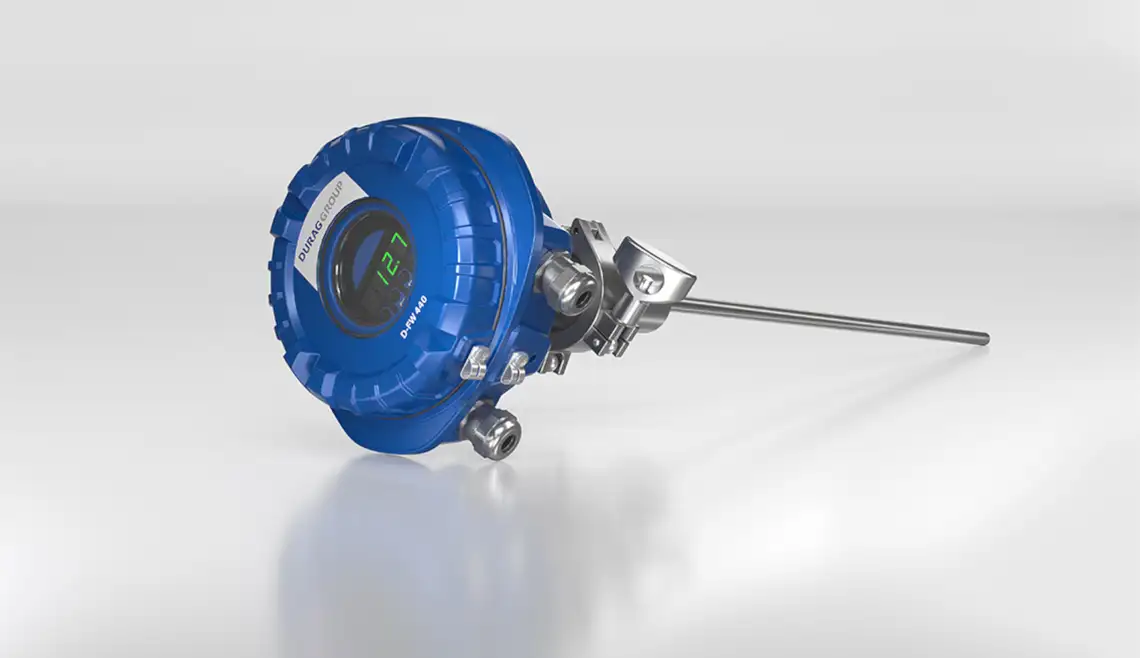
Our new triboelectric product line:

  • D-FW 410
    A compact, cost-effective detector designed for continuous filter leak monitoring. Its low-maintenance design makes it ideal for facilities seeking reliable performance with minimal upkeep.
  • D-FW 440 L
    TÜV-certified according to EN 15859 and US EPA capable, this model is optimized for trend analysis and process control. It helps operators detect gradual filter degradation and take proactive measures.
  • D-FW 440 D
    TÜV-certified to both EN 15859 and EN 14181 and US EPA capable this advanced dust filter monitor provides calibrated dust concentration output in mg/m³, helps meet dust emission limits, avoid fines, and minimize product losses due to filter failures.
Certified stack emission monitoring after complex filtration systems

Why measure at the stack?

The stack is the final release point into the atmosphere. Monitoring here ensures you're capturing true emissions, including leaks or bypasses downstream of the filter, residual dust not captured by filtration, re-entrainment or secondary emissions from ducts or fans.

Why certified systems are essential

After complex filtration, exhaust gases become more challenging to measure:

  • Lower dust concentrations require high-precision instruments
  • Wet or sticky gases (e.g., post-FGD) demand specialized monitors like the D-R 909
  • Variable gas compositions need high accuracy and robust calibration

Certified systems are engineered for these conditions and are mandatory under regulations like EN 15267 QAL1 and US EPA 40 CFR 60 PS 11.

DURAG GROUP’s certified particulate monitors:

  • D-R 320 – Scattered light in situ dust monitor for emissions compliance in power, cement, metal smelting, etc. offering single-side and non-intrusive installation, adapted for ATEX & IECEx zones and use in wide stack diameters, ensuring automatic checks, and the lowest certified range (0–7.5 mg/m³) for precise dust measurement.
  • D-R 808 – A robust in-situ PM-CEMS using backward scattering technology, QAL1 certified, compliant with US EPA 40 CFR 60 PS 11, designed for continuous and reliable particulate monitoring across industrial processes, including ATEX & IECEx zones.
  • D-R 290 – Compact and cost-efficient in-situ opacity monitor for continuous particulate measurement in industrial stacks, offering reliable performance for medium to high dust concentrations. Compliance with regulatory frameworks like EN 15267, and exceeding US-EPA and ASTM standards, ATEX & IECEx certified.
  • D-R 909 – Wet stack dust monitor for continuous particulate measurement in wet, sticky exhaust gases after FGD, wet scrubbers, and high-moisture dryers/boilers in industries such as power generation, waste incineration, pulp and paper, metallurgical, chemical, and drying processes. QAL1 certified for the range 0-7.5 mg/cm3, the lowest achievable on the market, US EPA 40 CFR 60 PS 11 compliant, cETLus listed (UL 61010-1).

Built for compliance and confidence

Certified systems include:

  • Automated zero and span checks
  • Contamination compensation
  • Long-term stability and traceability

These features ensure data integrity and support QAL1, QAL2, and QAL3 quality assurance levels as required by EN 14181.

Demonstrating environmental accountability

Using certified monitors shows your commitment to:

  • Environmental stewardship
  • Corporate responsibility
  • Transparent and compliant operations

It also helps avoid fines, shutdowns, and reputational risks.

Ready to elevate your dust monitoring strategy?

DURAG GROUP offers over 75 years of expertise in dust monitoring technology to meet the demands of modern industry. Whether you're upgrading existing systems or designing new installations, our team is ready to help you choose the right solution.