


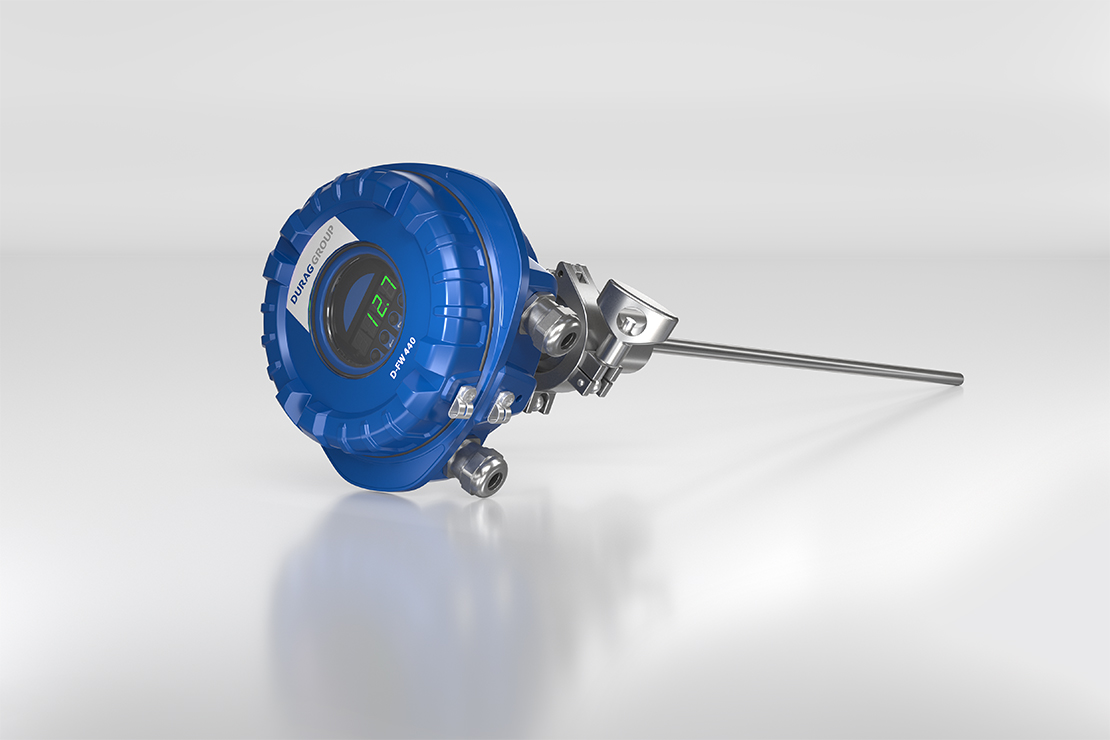
D-FW 440 D
Dust filter monitor certified to EN 15859
The D-FW 440 D is a cost-effective and highly reliable in situ filter monitor designed for real-time and continuous monitoring of particulates emitted from dust arrestment plants. Calibratable in mass concentration units (e.g. mg/m³) and engineered for low maintenance, it measures solid particles in gas flows with precision.
With certifications such as TÜV to EN 14181, EN 15859 and US EPA capable, the D-FW 440 D ensures safe operation while supporting environmental compliance and operational efficiency.
Technology: Triboelectric principle

Benefits
- Cost-effective dust filter monitoring
Ideal for dust arrestment plant control, trend analysis,and filter performance monitoring, in applications requiring dust concentration output (mg/m³) - Regulatory compliance made easy
Dust filter monitoring in accordance with EN 14181, EN 15267-1/-2, EN 15859, US EPA, and other international standards - Proven triboelectric technology
Reliable particle detection based on charge interaction – trusted in demanding industrial environments worldwide - Quick and easy installation
Compact and easy to mount, compatible with control systems – ready to measure in no time, perfect for upgrades or tight spaces - Seamless system integration
Standard 4 to 20 mA output signal and 2 independent alarm relays (normally open/closed) – ideal for process monitoring, trend analysis, or connection to PLC/control systems - Direct, in-situ measurement
No sampling or extraction – direct measurement within the gas duct for real-time accuracy - Maintenance-free operation
No moving parts, no consumables – reducing downtime and lowering long-term operating costs - Supports predictive maintenance
Detects changes in filter cleaning pulse magnitude or emission levels – enabling proactive maintenance and reducing unplanned downtime - Improved environmental and operational efficiency
Helps meet dust emission limits, avoid fines, and minimize product losses due to filter failures - Enhanced safety
Continuous monitoring reduces the risk of hazardous exposure and dust explosions - Versatile applications
Suitable for a wide range of industries including cement, steel, pharmaceuticals, power generation, and more
COMPLIANCE & CERTIFICATIONS
TÜV certified dust filter monitor according to:
- EN 15267-1 (2009)
- EN 15267-2 (2023)
- EN 15859 (2010)
- EN 14181 (2015)
US EPA capable
Applications
- Dust filter detection and dust arrestment monitoring
Ideal for continuous surveillance of industrial filtration systems such as baghouses, cyclones, and exhaust ducts – ensuring early detection of filter failures and effective dust emission control - Process control and trend monitoring
Supports efficient plant operation by detecting process disturbances (e.g., cleaning cycle issues, ventilation faults) and monitoring long-term trends to optimize filtration performance and prevent product loss - Broad industry suitability
Applicable across industries where dust control, regulatory compliance, and operational safety are critical:- Cement plants (e.g., mills, silo ventilation)
- Metalworking and welding (e.g., extraction systems in welding booths)
- Wood processing (e.g., sawmill filter systems)
- Agriculture and food industry (e.g., filtration systems on cereal conveyors, manufacturing powder milk, chocolate / coffee, etc.)
- Chemical and pharmaceutical manufacturing
- Plastics processing (e.g., dedusting systems, granulate separators)
For US EPA 40 CFR 60 PS 11 compliance, or EN 15267 QAL 1 certified PM CEMS monitors for stack emissions monitoring the suitable particulate monitors are: D-R 290 (opacimeter), D-R 808 (backward scattering), D-R 320 (single side, non intrusive, forward scattering) or D-R 909 (forward scattering, wet stacks)
Technical Data
- Technical data
| Measured parameter | Solid particles in gas flow |
|---|---|
| Measuring principle | Triboelectric, in situ measurement, single-sided installation |
| Measuring range | Detection limit 0.01 mg/m³Certification range: 0 ... 7.5 mg/m³Additional ranges: 0 ... 15 mg/m³; 0 ... 100 mg/m³Max. range up to several g/m³ depending on operating conditions and dust material |
| Protection rating | IP66 |
| Power supply | 24 V (±10%)100 ... 240 V~ ±10%, 50/60 Hz |
| Power consumption | Max. 10 W DC/AC |
| Output signals | 2x independent SPDT output signal relays, max. 30 V /5 A or 240 V~/5 A, cos = 1Isolated active 4 ... 20 mA output loop, max. loop resistance 250 Ω, certified to EN 15859 |
| Communication interface | 2× RS-485 (serial), 1× USB |
| Communication protocol | Modbus RTU (with RS-485), compliant with VDI 4201 |
| Ambient conditions | Temperature: –20 … 50 °C (–4 … 122 °F)Humidity: Max. 95% relative humidity (non-condensing) |
| Process conditions | Temperature: Max. 300 °C (572 °F), optionally up to 700 °C (1,292 °F)Pressure: Max. 600 kPa (87 psi) in temperatures up to 300 °C (572 °F)Max. 300 kPa (43 psi) in temperatures 300 °C (572 °F) … 700 °C (1,292 °F) when high-temperature process connection is usedFlow velocity: Min. 3 m/s (9.84 ft/s), max. tested 40 m/s (131.23 ft/s) |
| Operation and configuration | Optional: D-ESI FW software |
| Material | Housing: Aluminium, paintedProbe: Stainless steel (316L)Insulation: Polyphenylene sulfide (Ryton R-4) |
| Probe dimensions | Standard length: 500 mm (19.69″); Other lengths on request – up to 1,750 mm (68.90″) in 250 (9.84″) or 500 mm (19.69″) increments |
| Weight | 1.5 kg (3.3 lb) without probe |